
Earls Barton Pharmacy | Website article | Reviewed 27 October 2026
Booking flights and hotels is the fun part of planning a trip. Travel vaccinations are easy to forget until a week before you leave, and by then some vaccines can’t give you full protection in time.
So how early should you start? This guide gives you a clear timeline, explains how long each common travel vaccine needs, and shows what you can still do if your trip is only days away.
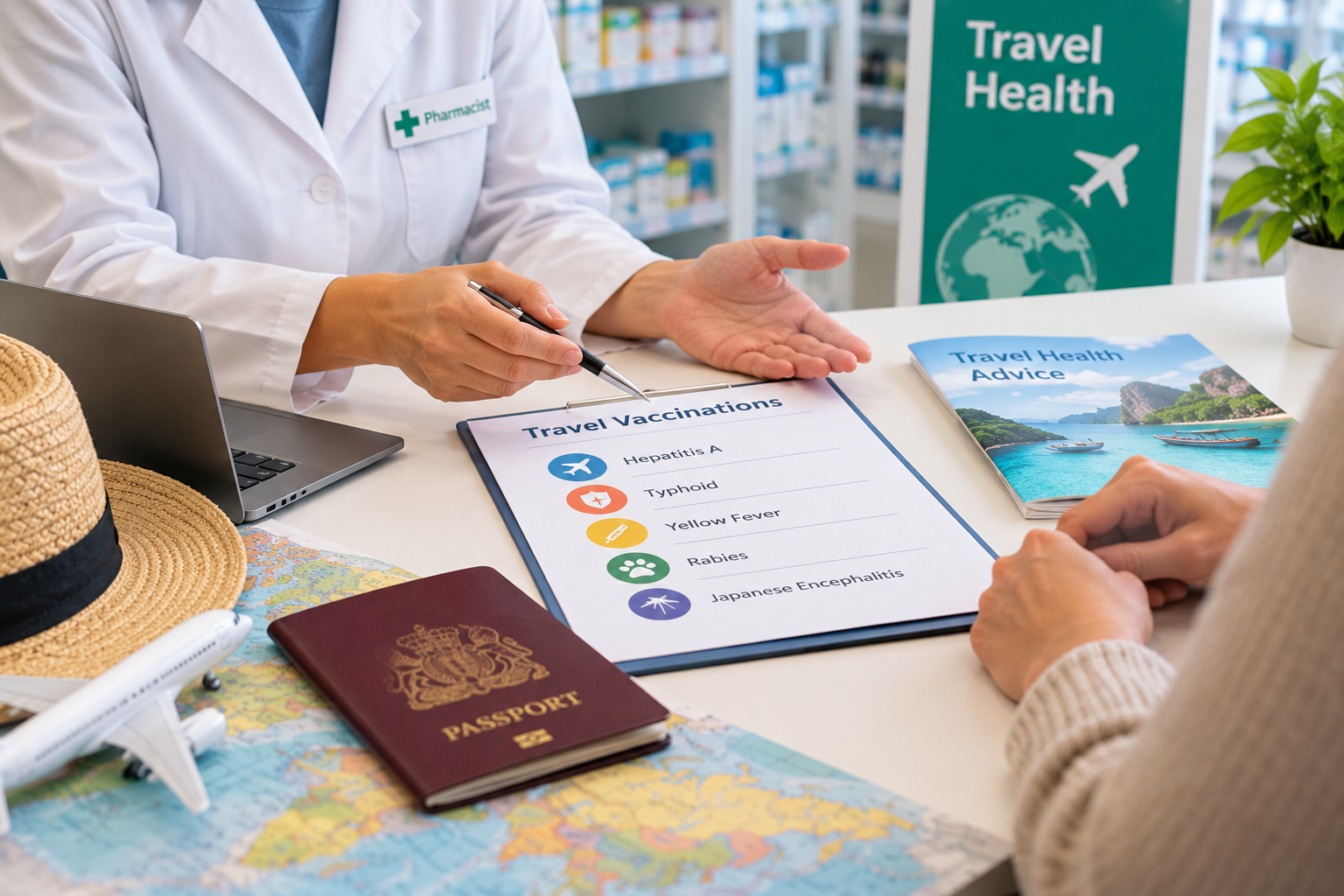
The short answer
Aim to see a travel health professional 6 to 8 weeks before you travel. The NHS recommends at least 4 to 6 weeks. Start earlier if you’re visiting several countries or need vaccines given as a course, such as rabies or hepatitis B. If you’re leaving sooner, still book: some vaccines can still be worthwhile, although protection may be incomplete when you travel.
Why timing matters
Two things decide how early you need to start:
Some vaccines need more than one dose. Rabies, for example, is a course of three injections spread over three to four weeks. Japanese encephalitis and hepatitis B also need more than one dose.
Your body needs time to respond. After a vaccine, it takes time for your immune system to build protection. The yellow fever certificate, for example, only becomes valid 10 days after you’re vaccinated.
Vaccination reduces risk but does not guarantee complete protection. Continue mosquito bite prevention, food and water precautions and other advice appropriate to your destination.
Starting early also gives you time to sort out malaria tablets, travel medicines and any vaccines you’ve missed in the UK schedule, without squeezing everything into your last week.
Your travel vaccination timeline
- Book your travel health consultation, especially for long trips, backpacking or rural travel.
- Check your destination's entry requirements, such as a yellow fever certificate.
- Find your vaccination records so the pharmacist can see what you've already had.
- Have your consultation and start any multi-dose courses, such as rabies, hepatitis B or tick-borne encephalitis.
- Get advice on malaria risk for your destination.
- Have second or third doses as planned.
- Finish single-dose vaccines that you haven't had yet.
- Aim to have completed the doses recommended before departure, allowing time for an immune response. Some later doses may be needed for longer-term protection.
- Collect malaria tablets and any travel medicines, such as treatment for travellers' diarrhoea or altitude sickness tablets.
- Start malaria tablets on the date advised by your pharmacist; some must be started well before the final week.
- Pack your vaccination certificate or record.
How long each travel vaccine needs
The table below gives example adult schedules and suggested planning times. These are not guarantees of protection or fixed cut-off dates. Advice depends on your age, health, previous vaccinations, itinerary and the exact vaccine used. Children may need different schedules.
| Vaccine | Example schedule | Suggested planning time |
|---|---|---|
| Rabies | Usually days 0, 7 and 21 or 28. Accelerated days 0, 3 and 7 may be appropriate; a later dose may be needed. | Ideally 3 to 4 weeks or longer; seek advice even if leaving sooner. |
| Hepatitis B | Usually 0, 1 and 6 months. Suitable adults may use days 0, 7 and 21, plus a fourth dose at 12 months. | Start early. Three weeks allows the first three very rapid doses, but protection is not immediate or guaranteed. |
| Japanese encephalitis | Days 0 and 28; adults aged 18 to 65 may use days 0 and 7. | Complete at least 1 week before exposure; the rapid course needs at least 2 weeks. |
| Tick-borne encephalitis | Three doses. With TicoVac, dose 2 is at 1 to 3 months, or after 14 days if necessary; dose 3 is 5 to 12 months after dose 2. | Start as early as possible. Allow time after dose 2 for an immune response; the full course takes months. |
| Cholera oral vaccine | Dukoral: two doses for adults, at least 1 week and less than 6 weeks apart. | Complete at least 1 week before exposure; allow at least 2 weeks. |
| Hepatitis A | One initial dose; a later dose provides longer-term protection. Timing depends on the product. | Ideally at least 2 weeks, but seek advice even close to departure. |
| Typhoid injection | One dose; repeat every 3 years if continuing risk. Oral vaccine has a different schedule. | Ideally at least 2 weeks. |
| Diphtheria, tetanus and polio | Booster if indicated after reviewing your vaccination history. | Seek advice even at short notice. |
| Meningococcal ACWY | Usually one dose for travellers when indicated. | Hajj and Umrah have certificate timing and validity rules; check current requirements. |
| Chikungunya | Vimkunya: one dose for eligible travellers aged 12 years and over, after risk assessment. | Book early and ask about time to develop an immune response. |
| Yellow fever | Usually one dose at a registered centre, after individual risk assessment. | First certificate valid from 10 days after vaccination; certificate validity is lifelong. |
Yellow fever vaccine is only given at registered centres, which you can find through the NaTHNaC yellow fever centre search.
A note on dengue: the dengue fever vaccine is usually only recommended in the UK for people aged 4 and over who have had dengue before. It’s given as two doses three months apart, so it needs much longer planning. Ask about it at your consultation if you’ve had dengue in the past.
Don't forget malaria tablets
If you’re travelling to a malaria area, tablets are just as important as vaccines. There is no single start date: some antimalarials are started a few days before you travel, while others need to be started a week or more beforehand, and all of them are continued for a set time after you get home.
Malaria prevention tablets for travel are normally supplied privately and are not available on NHS prescription for this purpose. Our pharmacists can recommend the right malaria tablets for your destination, health and budget. Raise malaria at the same appointment as your vaccines so you leave with everything sorted.
Travelling to a Malaria-Risk Area?
Find out whether malaria prevention may be recommended for your destination and when to seek advice before you travel.
Leaving in less than 2 weeks? You can still get protected
Do not cancel your appointment just because time is short. Vaccines such as hepatitis A may still be worthwhile close to departure, while other vaccines may not provide adequate protection in time. Rapid schedules exist for suitable travellers for rabies, hepatitis B and Japanese encephalitis. Your pharmacist will explain their limitations.
Rabies safety: even after pre-travel vaccination, an animal bite or scratch requires immediate thorough wound washing and urgent medical assessment for further treatment.
If you leave vaccination until the last minute, you may not be adequately protected during your trip. Your pharmacist will prioritise the vaccines most relevant to your itinerary, explain the limitations of incomplete courses and agree a plan for any further doses. Do not assume that completing a course after returning will protect you during the trip.
Travelling soon? Contact Earls Barton Pharmacy to check appointment availability.
Travelling Soon? Plan Your Travel Vaccinations
Our friendly team at Earls Barton Pharmacy can help you understand which travel vaccinations and malaria prevention options may be suitable for your destination.
Which travel vaccines are free and which do you pay for?
- Some travel vaccines are available free on the NHS through GP surgeries when clinically indicated following a travel risk assessment. These include:
- Hepatitis A
- Typhoid
- Cholera
- Polio (given as the combined diphtheria, tetanus and polio vaccine)
Others usually have to be paid for, including hepatitis B, Japanese encephalitis, rabies, tick-borne encephalitis and yellow fever.
Not every GP surgery offers travel vaccines, and appointments can be hard to get at short notice. This is why many people choose private travel vaccinations at a pharmacy and get everything done in one place.
How to prepare for your travel clinic appointment
Your consultation will be quicker and more useful if you bring:
- Your full itinerary, including countries, regions and any rural or remote areas.
- Your travel dates and how long you’ll be away.
- Your vaccination history or records, if you have them.
- A list of your current medicines and any medical conditions.
- Details of activities such as trekking, diving or working with animals.
Tell the clinician if you are pregnant, breastfeeding, immunosuppressed, or have previously had a serious reaction to a vaccine.
Going on Hajj or Umrah? Read our guide to Hajj and Umrah vaccines. For a vaccine-by-vaccine overview, see our travel vaccination checklist.
FAQ
Ideally 6 to 8 weeks before you travel, and at least 4 to 6 weeks according to the NHS. Allow longer for multi-dose courses or trips to several countries.
Some vaccines may still be worthwhile, but vaccination the day before departure does not provide immediate protection. A pharmacist will assess the likely benefit and explain any remaining risks or certificate requirements.
For a first yellow fever vaccination, the certificate becomes valid 10 days after vaccination and remains valid for life. Vaccination must be given at a registered yellow fever centre. Contact us early for advice on accessing a registered centre.
For many vaccines, yes. Hepatitis A, typhoid and the tetanus booster can be given at short notice, and some courses have rapid schedules. You may not be fully protected against everything, so book as soon as you can.
The usual UK course is three doses on days 0, 7 and 21 or 28. An accelerated course on days 0, 3 and 7 may be appropriate after assessment, with a further dose at one year if ongoing risk continues. Your clinician will select the schedule for your age, vaccine and circumstances.
Some are free on the NHS through your GP surgery. Others, such as rabies, hepatitis B and Japanese encephalitis, have to be paid for. A private travel clinic can assess your needs and start recommended vaccinations at your appointment. Some vaccines require further visits.
Conclusion
Book your travel health appointment 6 to 8 weeks before departure whenever possible. This allows time to start recommended courses, receive the doses needed before travel and arrange malaria prevention. Some courses, including standard hepatitis B vaccination, take longer. If your trip is sooner, a pharmacist can assess the most useful options and explain any remaining risks.
Ready to plan your trip? Book a travel health consultation with Earls Barton Pharmacy through our website. Contact the pharmacy for current appointment availability, consultation fees and vaccine prices.
Getting Ready for Your Next Trip?
Plan ahead and speak to our team about your travel health needs before departure.
Disclaimer: All information in this article has been checked for accuracy at the time of publication. However, we cannot guarantee that it is entirely free from errors or omissions and accept no liability for any inaccuracies or omissions. This information is intended for general guidance only and should not replace professional medical advice.


